.svg)


Have you
SUBSCRIBED?
Keep up with Cornish Life
International Women's Day: The women of Scarne Farm
International Women’s Day was held on 8th March, giving us all the chance to celebrate the special women in our lives - whether it’s a close friend or relative, a teacher or carer, or an inspirational figure in the past or present. Here, we look at a story close to home, where many women – often for the first time - were given the opportunity to prove themselves while war raged in Europe.
International Women's Day: The women of Scarne Farm
International Women’s Day was held on 8th March, giving us all the chance to celebrate the special women in our lives - whether it’s a close friend or relative, a teacher or carer, or an inspirational figure in the past or present. Here, we look at a story close to home, where many women – often for the first time - were given the opportunity to prove themselves while war raged in Europe.
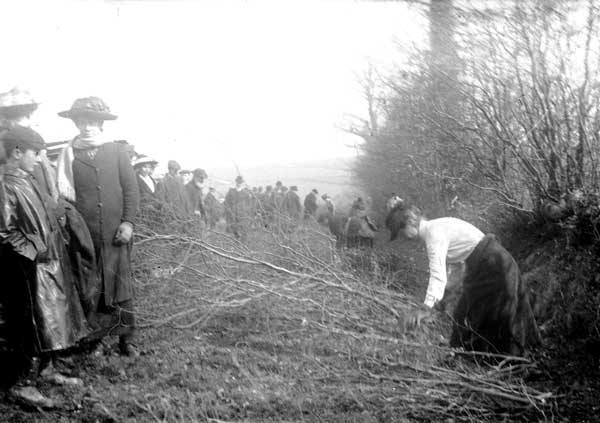
When the nation’s men answered Lord Kitchener’s call and went to fight on the Western Front from 1914 to 1918, there were important discussions taking place to address the country’s depleted workforce. Suddenly, women were given the chance to step forward in many different capacities - away from the responsibilities at home that had so long held them back.
In December 1915, a meeting of the Launceston, Camelford and Stratton District War Agricultural Committee was held. Its purpose? To discuss the viability of women’s labour on farms. With news of casualties and fatalities continuing to flood in from the Front, and with military conscription looking to become a likely occurrence in the coming months, a strong message came from chairman Mr J Parnell of St Gennys, who urged the committee to consider the need for women’s labour in the future, and that the Board of Agriculture should be contacted for posters urging women to step forward. After canvassing the area to gauge local women’s opinions on the work, a great many were keen to do their bit, and so plans were put in place to stage a wood binding challenge for those women who had expressed an interest in the work.
The challenge was set to take place at Scarne Farm, Launceston, with the addition of farmyard manure spreading, hedge paring, and wood-sawing on top of the original wood binding challenge, with hopes to raise funds for the local branches of the Red Cross.
The event took place at Scarne Farm by permission of farmer Thomas Hicks, and was supported by Lady Molesworth St Aubyn, on Thursday, 9th March 1916. There was a huge turnout, with the participants proving themselves to be more than capable - coming away with cuts, bruises and skirts torn and muddied by the work.
In April, a meeting of Cornwall’s Committee of War Service for Women acknowledged that 350,000 men had been drawn from agriculture, and that women would have to stand in their place to ensure the country’s food supply was maintained in increasingly turbulent times.
Thanks to the participants and organisers of the Scarne Farm trials, Cornwall was seen to be a leading force in the introduction of women’s agricultural work. Elsewhere over the war years, women found work or volunteer roles in munitions factories, military service such as the Women’s Royal Naval Service (the Wrens), and nursing both at home and in field hospitals on the front line.
You can read all about the Scarne Farm event, and how women in the local area were given the opportunity to take up farm work, at https://launcestonthen.co.uk/index.php/the-war-years/launceston-and-world-war-one/women-and-the-land-army/| Launceston Then!
With thanks to Roger Pyke of Launceston Then!



_web.webp)